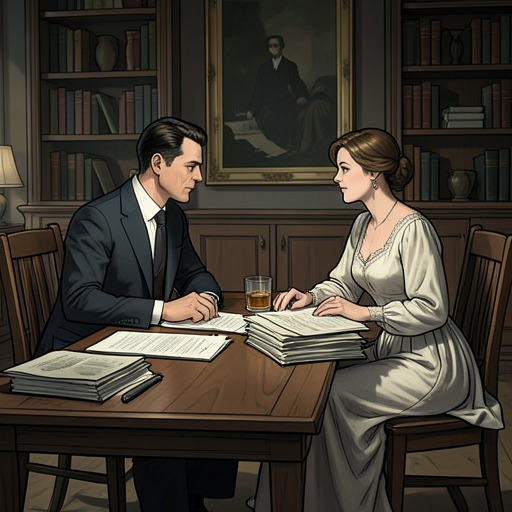
Zelda Fitzgerald’s First Mental Breakdown
A Moveable FeastZelda Fitzgerald’s First Mental Breakdown is presented not through an account of its onset but through what Ernest Hemingway says changed afterward: F. Scott Fitzgerald’s knowledge of Zelda’s condition, and the eventual return of good writing. The recollection places that change beside an earlier, intimate exchange with Zelda and a later lunch with F. Scott Fitzgerald in Paris, leaving the event’s force in its consequences rather than its symptoms.
Retrospective Placement
Hemingway identifies the episode retrospectively as Zelda’s first nervous breakdown, using the term by which it was then known. He recalls that, much later, Zelda and F. Scott Fitzgerald were in Paris at the same time and that F. Scott Fitzgerald asked him to lunch at Michaud’s. The book supplies no scene of the breakdown itself, no date for it, and no description of its symptoms; its narrative presence comes through this later framing.
The Earlier Confidence
The recollection sets the later knowledge against an earlier meeting at a villa near Juan-les-Pins. Zelda appeared beautiful, friendly, and calm to Hemingway. She leaned toward him and shared her private, startling opinion that Al Jolson was greater than Jesus. At the time, Hemingway says, nobody thought anything of it: it was a secret she had shared with him. His image of a hawk sharing something with a man, followed by the insistence that hawks do not share, makes the exchange feel both intimate and difficult to interpret in retrospect. The text does not identify this moment as a sign or cause of the breakdown.
Consequences for F. Scott Fitzgerald
Hemingway makes a stark claim about the aftermath: F. Scott Fitzgerald wrote nothing good until after he knew Zelda was insane. The phrasing links his recognition of her condition with a later change in his work, while leaving the nature of that relationship unexplained. Rather than narrating a recovery or a specific turning point in his writing, the account marks a before and after: the breakdown becomes legible through what F. Scott Fitzgerald knew and what Hemingway says followed that knowledge.
The Later Paris Lunch
At the later lunch, F. Scott Fitzgerald warned that he had something very important to ask and required an absolutely truthful answer. Hemingway recalls that attempts to answer him truthfully could make him angry, sometimes much later, after he had brooded over the words. They discussed work and acquaintances before F. Scott Fitzgerald raised his question over cherry tart and a last carafe of wine: he said he had never slept with anyone except Zelda. The episode does not disclose Hemingway’s answer in the supplied passage. Its placement after Zelda’s breakdown instead shows the marriage still at the center of F. Scott Fitzgerald’s private concerns, while the narrator’s caution makes truth itself feel consequential and potentially destructive.